
Written by Eugene Morgan
Zen Story
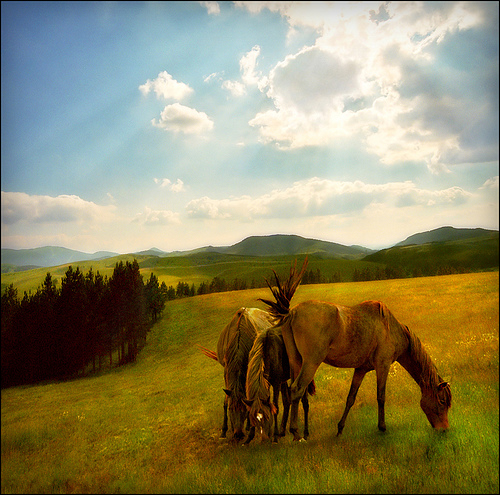
A farmer was fortunate to have one horse, unlike most people in his village. One day the farmer’s horse ran away. Because it was a small village the news spread quickly about the runaway horse. One of the neighbors said to the farmer, “I am so sorry for your loss, that’s unfortunate.” “Maybe,” replied the farmer. However, the next morning the horse returned to the farm with two wild horses. Again the news spread about the farmer having his returned horse along with two more wild horses. Another neighbor said to the farmer, “This is wonderful news, lets us celebrate.” “Maybe,” the farmer replied. The next day, the farmer’s son tried to ride on one of the wild horses. But the son was thrown from the horse and broke his leg. Upon hearing about his son’s accident, the neighbors offered sympathy. “Maybe,” replied the farmer. On the same day, a group of recruiters happened to arrive to the village searching for young men to draft for war. One of the recruiters happened to pass up the farmer’s son because of his broken leg. One neighbor saw this and displayed his joy in front of the farmer. “Maybe,” replied the farmer.
The Conscious vs. The Unconscious Mind
This is one of my favorite Zen stories because it illustrates a primary difference between the conscious and the unconscious mind. In the story, the conscious mind represents the neighbors and the unconscious mind represents the farmer. The events that took place in the Zen story, the neighbors responded with interpretations based on personal criteria of what was fortunate or unfortunate, and, with the farmer responded with the word, “Maybe” based on no criteria of what was fortunate or unfortunate. The unconscious mind does not perceive events bad, good or indifferent. It just perceives and processes events. However, the conscious mind does perceive events— bad, good or indifferent. Blinded with interpretations, judgments, and rigid frames of reference— what makes the conscious mind non-objective. This is what gets us into trouble and creates problems. But the unconscious mind perceives things as they are just as the farmer did in the story; he saw the events that were taking place as is. “People who accomplish a great many things are people who have freed themselves from biases. These are the creative people,” Milton Erickson. In other words, creative people have learned how to tap into their unconscious mind.
So the unconscious mind perceives and processes events beyond the conscious perception. The conscious mind is not aware of the unconscious but the unconscious is very much aware of the conscious mind. “The unconscious works without your knowledge and that is the way it prefers,” Milton Erickson. And it’s impossible to remember every thing we have learned consciously. Most of our learnings are transferred to the unconscious mind.
Emotions and The Unconscious Mind
What about our emotions? Where does our emotions come from? The emotions come from the unconscious mind, not the conscious mind. Our unconscious mind tells us consciously how we feel about a situation. It paints a picture of the events that are taking place around us. “We should be willing to feel fully the pleasures and the happiness that we want, because all our feelings are done by ourselves. In a similar way many emotional problems can be solved more easily without conscious thinking.” Milton Erickson.
Nonverbal Learning and The Unconscious Mind
Before we were able to communicate verbally, we first learned how to communicate non-verbally. When we first saw a smiling face, we began to learn how to smile back. When we first saw a frowning face we began to learn how to frown. The unconscious mind learned the facial patterns of a smile, before we could smile back. Generally, when someone smiles at us, we automatically elicit a smile. And this creates a feeling of joy. Just as a frown face creates feeling of sadness. We have all experience this.
Logic and the Conscious vs. The Unconscious Mind
The unconscious mind is spontaneous, intuitive, and understands metaphors and symbols, while the conscious mind is logical, rational and abstract. Milton Erickson observed in subjects that, although, the learning is a difficult process for the conscious mind, the unconscious mind does the lion’s share of the work.
For example, teaching a child how to ride a bike for the first time is difficult. We would think, since most of us know how to ride a bike, therefore, we can teach easily a child how to as well. Since it’s easy to ride a bike, we can easily teach a child how to ride a bike. But we forget that when we first learned how to ride a bike it was very difficult. There were many variables that we had to learn. We had to learn how to keep our balance on the bike without falling, learn how to use eye and hand coördination and learn how to use the muscles in our legs that we normally don’t use to push the pedals. And we had learn how to do all these things simultaneously.
Therefore, the child has to learn how to ride a bike through experience. The child has to learn how to get on a bike. Even though you are holding up the bike, the child has to learn first the feel of the bike; adjust herself to the seat of the bike while both feet are on the pedals. We can only guide her by holding and pushing the bike until she gets use to it. For her to learn how to keep her balance on the bike, she would have to ride it without us holding her up. This means falling a dozen times before she learns the experience of riding a bike.
Regulating systems and the Unconscious Mind
“Human beings, once they have learned anything, transfer this learning to the forces that govern their bodies,” Milton Erickson. The unconscious mind is responsible for regulating all systems such as the nervous system, digestive system, circulatory system, urinary system and the reproductive system, and etc.,
Click this button for my new book:







You must be logged in to post a comment.